
Two Light Sensors on One Satellite Disagreed in 1979, and So Did Washington
A satellite that had confirmed 41 nuclear flashes recorded a 42nd over the South Atlantic in 1979. Government panels, labs and later scholars still read the signal differently, and key reports remain classified.
Significance 5/10: A flawless nuclear-detection satellite gave one ambiguous signal, and four decades of records still haven't settled it.
Coverage we found: no other coverage In the past five years (October 2021 to October 2026) (searched October 27, 2026).
How we scored this
- Strength of evidenceThe article rests on declassified records and official panel reports, but they are curated archive collections and scholarly reanalyses. Key reports (DIA, NRL, Nuclear Intelligence Panel) remain classified or redacted.
- Effect on practice or understandingThe record informs how the event is understood. It does not settle the cause, and Wright and De Geer's conclusion is "a scholarly judgment, not an official finding."
- ReachThe subject is nuclear-test detection and verification, which is a specialist field in intelligence and arms control.
- StakesThe article ties the answer to diplomatic consequences, with State and NSC memos on how to approach South Africa. It shows no direct safety, dose or cost consequences.
- SurpriseA detector with 41 confirmed double flashes gave a nearly-but-not-quite usual signal, and government bodies read it in opposite ways. That adds meaningfully but does not contradict what the field assumes.
Coverage found
- The Collector other, 2023-12-07
- Wikipedia other
- Intel Today other, 2025-09-22
- AnomalyDesk other
- The Conspiratory other
- WorldAtlas other
- Nuclear Age Peace Foundation other
Only news, trade and journal coverage is counted. Press releases and other sources, such as reference sites, blogs, social posts and stock-news reprints, are listed but not counted. Searches miss things: tell us about coverage we missed. How the Unread Index works.
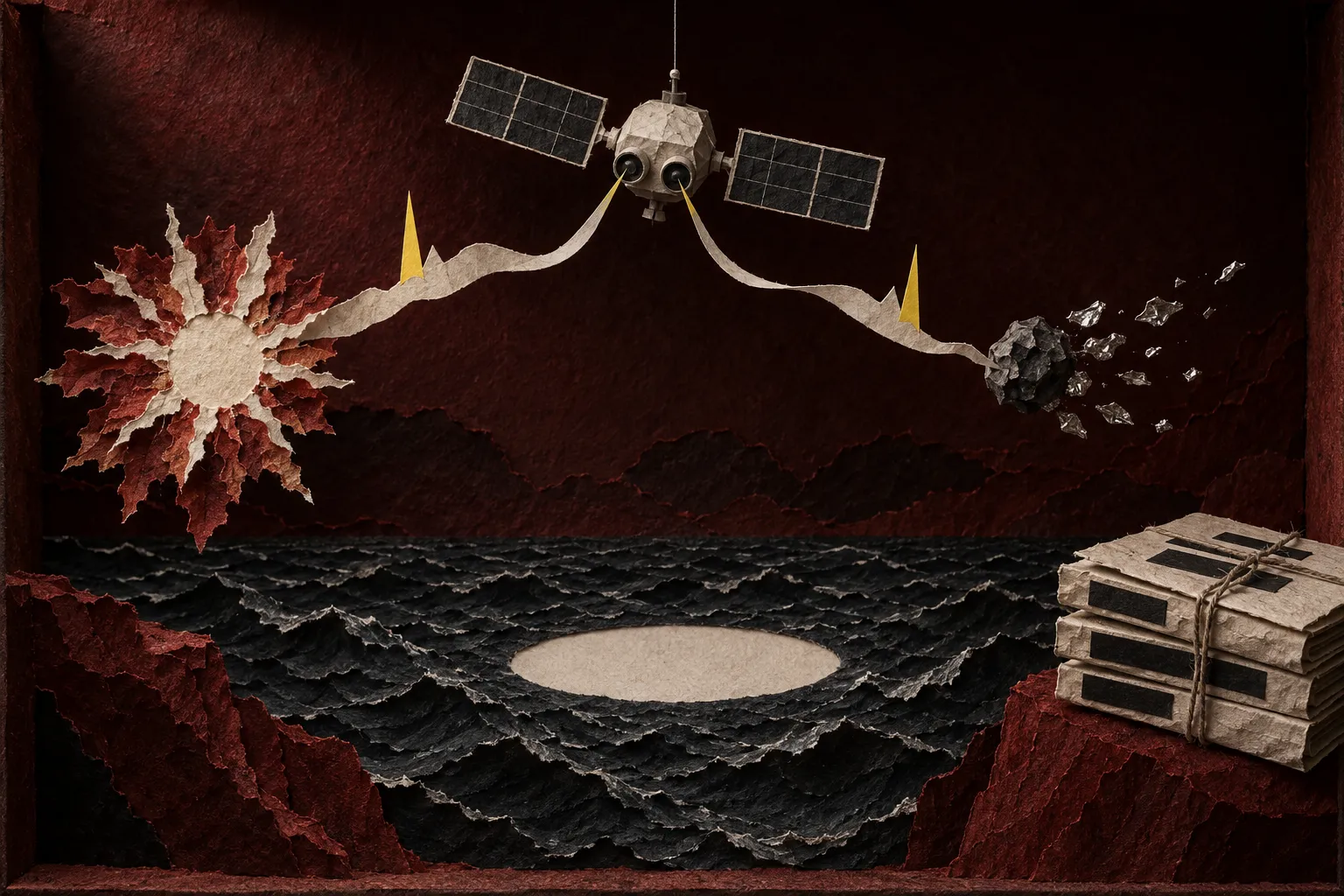
At about 3 a.m. local time on September 22, 1979, a satellite designated Vela 6911 recorded two flashes of light from the region of the South Atlantic: a brief, intense one, then a longer one. The spacecraft had been in orbit since May 23, 1969, and was by then ten years old and more than two years past its “design lifetime”. That double flash became the Vela incident, and more than four decades of declassified paperwork have not settled what produced it.
Vela satellites had seen 41 earlier double flashes, 12 of them by Vela 6911, and every time later data confirmed a real nuclear detonation. The 42nd was nearly the usual signal, but not exactly. If it was a test, someone had set off a nuclear device in the atmosphere in secret, and President Jimmy Carter’s diary framed the possibilities as “either South Africa, Israel using a ship at sea, or nothing.”
How Vela 6911’s bhangmeters read a flash
Besides gamma-ray, X-ray and neutron sensors, Vela 6911 carried two bhangmeters. A bhangmeter is an optical detector built to catch the light signature of an atmospheric nuclear explosion, which arrives as an initial brief, intense flash followed by a longer second flash.
Optical sensors in orbit see plenty of light that has nothing to do with weapons. In a November 1979 analysis, Barasch of Los Alamos noted that bhangmeters had been triggered hundreds of thousands of times by lightning, cosmic particles and direct sunlight. He still judged the nuclear light signature “unmistakable,” and he rejected the suggestion that a lightning “superbolt” had produced the September signal.
The trouble was in the comparison between the two instruments. The bhangmeters were not expected to give identical readings, but the ratio between them was expected to stay constant through an event. This time it did not.
Two panels, one 1979 signal
The first formal assessment leaned toward a test. In October 1979 a panel sponsored by the Central Intelligence Agency (CIA) found the signals “consistent with detection of a nuclear explosion in the atmosphere.” By October 22, the National Security Council staff had circulated a discussion paper titled “South Atlantic Nuclear Event.” The physicist Richard Garwin wrote in an October 19 letter that he would “bet 2 to 1 in favor” of a nuclear explanation.
On November 1, an ad hoc panel known as the Ruina panel began work. Its members included Garwin, Luis Alvarez and Wolfgang Panofsky. Its report, dated May 23, 1980, concluded that the signal “was probably not from a nuclear event,” a finding Panofsky called a “scotch verdict,” meaning not proven. Garwin had by then changed his mind.
The panel’s alternative was mechanical. A meteoroid might have struck the satellite, ejecting particles that reflected sunlight into the bhangmeters.
Others inside the government did not accept it. The Defense Intelligence Agency (DIA), the national laboratories and contractors concluded that Vela 6911 had detected a nuclear detonation, and on June 26, 1980, the DIA produced a paper titled “The South Atlantic Mystery Flash: Nuclear or Not?” The same recording had produced opposite answers inside the government, and the record has never reconciled them.
Searching for corroboration
A single satellite reading needed support, and the search for it kept coming back ambiguous. According to a May 1980 Los Alamos paper by Horak, the bhangmeters on two Defense Support Program satellites, DSP 6 and DSP 7, which could see the South Atlantic, did not trigger. Horak offered two explanations: the event was outside their field of view, or clouds weakened the signal. A Sandia National Laboratories assessment found that only Vela 6911 had detected the double flash.
Other searches looked for radioactive debris that could corroborate the flash. The Air Force Technical Applications Center sent aircraft to sample the air, and the CIA collected tree leaves, efforts that apparently were futile. A report of radioactivity in New Zealand rainwater was found to be a “false alarm.”
Then there were the sheep. An iodine-131 measurement in Australian sheep entered the record as possible evidence of fallout. Iodine-131 emits beta particles and weak gamma rays and has a half-life of 8.02 days, and in fallout it can be ingested in food or water, which is why grazing animals were a plausible place to look. The 2006 briefing book dates the slaughter to November 1979 in Melbourne, while the 2019 book places it in Australia in October 1979.
The ionosphere offered something stranger. The Arecibo observatory detected a traveling ionospheric disturbance, a wave moving through the upper atmosphere’s charged layer, heading unusually northward. The Department of Energy said it “possibly may confirm” the Vela signal, but the Ruina panel would later discount the Arecibo data.
Underwater sound followed a similar arc. A State Department memo records a claim of hydroacoustic signals unique to nuclear shots at sea. The Naval Research Laboratory (NRL) determined that the source of the sound was the Prince Edward Islands. The laboratory now says it cannot locate that report.
What the White House concluded, and what stayed classified
Documents posted in 2019 sharpen the split. A 1980 White House memo says the CIA’s “Safeguards-D” report “assessed the probability of a nuclear test as 90% plus.” White House staff agreed to hear dissenters “so that we can more safely ignore them.” Policymakers concluded that “we don’t know what happened,” while scientists inside the government kept disagreeing.
Much of the technical case remains out of view. The Director of Central Intelligence’s Nuclear Intelligence Panel report was released fully redacted, and the DIA report remains classified.
Wright and De Geer on an aging satellite
In 2017, Christopher M. Wright and Lars-Erik De Geer revisited the double flash in Science & Global Security. They argued that the satellite’s solar-panel geometry would have carried meteoroid debris away from the sensors’ field of view. They attributed the ratio anomaly to background modulation, abnormal or starting early, in an aged satellite. In 2018 De Geer and Wright published a paper on radionuclide and hydroacoustic evidence for a nuclear explosion. Theirs is a scholarly judgment, not an official finding.
That leaves the reports that bear most directly on the question: the NRL study, the DIA paper and the Nuclear Intelligence Panel report. If they were ever opened, would the sound traced to the Prince Edward Islands and the ratio anomaly point the same way?
About the sources: The National Security Archive briefing books are curated collections that describe and reproduce declassified documents: Briefing Book 190 (2006, edited by Jeffrey Richelson), Briefing Book 570 (2016, edited by William Burr and Avner Cohen) and Briefing Book 686 (2019, edited by Burr, Cohen and Wolfson). The editors of Briefing Book 570 say openly that they side with the nuclear view, and they also write that no smoking gun exists to attribute a test to any state. The editors of Briefing Book 686 write that South Africa “could not be a suspect,” which is their view. The Wright and De Geer papers were published in Science & Global Security.
Edited by a healthcare imaging professional with more than 25 years of experience in the field. How we report and edit.
Read next