
The Nuclear Files
The Only U.S. Commercial Reprocessing Plant Is Gone, but Its Glass Waste Has Nowhere to Go
West Valley's reprocessing plant ran about six years, and demolishing its main building took nearly three. Its vitrified waste sits on a storage pad with no disposal facility, and the final cleanup decision is still open, with 2010 estimates from $0.5 billion more to $8.2 billion.
Significance 5/10: The only U.S. commercial reprocessing plant is gone, but its glass-encased waste still has nowhere to go.
Coverage we found: 1 mainstream news outlet, 1 trade outlet In the past five years (searched October 13, 2026).
How we scored this
- Strength of evidenceThe facts come mainly from official DOE, NRC and NYSERDA reports, plus one secondary analysis (von Hippel, 2020), and not from a trial or a regulatory decision.
- Effect on practice or understandingThe story documents the whole reprocessing chain, from fuel in to glass canisters out, and informs the account of the site without changing any guideline.
- ReachIt concerns one site in western New York and the one U.S. commercial reprocessing plant.
- StakesThe article gives clear cost consequences: $1.4 billion spent by DOE by 2017, and 2010 estimates of $0.5 billion to $8.2 billion for the final phase. It also notes that the high-level waste has no disposal facility.
- SurpriseA decades-long cleanup with no repository for the waste is what readers in the field would expect.
Coverage found
- ANS / Nuclear Newswire (Radwaste Solutions) trade press, 2025-06-20
- Salamanca Free Press mainstream news, 2025-06-24
Only news, trade and journal coverage is counted. Press releases and other sources, such as reference sites, blogs, social posts and stock-news reprints, are listed but not counted. Searches miss things: tell us about coverage we missed. How the Unread Index works.
By June 2025, the Main Plant Process Building at the West Valley reprocessing plant in western New York was gone. Demolition had started in September 2022. When the Department of Energy (DOE) announced its completion, Roger Jarrell, Principal Deputy Assistant Secretary for Environmental Management, said the project had reduced radioactivity in the building by over 98 percent and removed more than 7 miles of contaminated piping.
The building had reprocessed spent nuclear fuel for about six years. Demolishing it took nearly three. Its most lasting product is still on the site, as glass-encased high-level waste.
The West Valley reprocessing plant was the only commercial reprocessing plant ever operated in the United States. It offers a complete physical record of reprocessing, from fuel arriving at the door to plutonium leaving it, and from a tank of leftover liquid to sealed glass. Contamination did not stay inside the building. Pipes under the Main Plant Process Building leaked strontium-90 and other liquid waste into the ground, the source of what the site’s citizen task force calls the North Plateau Groundwater Plume. A permeable treatment wall was installed in 2010 to capture the strontium-90.
Six years at the West Valley reprocessing plant
The arrangement dates to 1962. That year, Nuclear Fuel Services agreed with the Atomic Energy Commission (AEC) and the State of New York to build and run the plant, along with two burial grounds and four underground waste tanks.
The plant’s work left two lasting results: recovered plutonium and a highly radioactive liquid waste that stayed behind.
Between 1966 and 1972, under an AEC license, the plant processed 640 metric tons of spent fuel. According to Frank von Hippel, writing for the International Panel on Fissile Materials (a nonproliferation group), that work yielded about 1.5 metric tons of plutonium. He reported that the AEC paid the equivalent of $60 per gram in 2020 dollars for plutonium separated at West Valley.
A shutdown for upgrades that never ended
In 1972 the plant shut down for modifications intended to improve reliability and expand capacity. It never reprocessed fuel again. New federal requirements for earthquake and tornado protection and for waste management arrived during the shutdown, and von Hippel put the cost of the required upgrades at $340 million, about $1.2 billion in 2020 dollars.
The operator chose not to pay it. Nuclear Fuel Services, which Getty Oil had acquired in 1969, stopped accepting waste for burial in 1975 and ended all operations in 1976.
In 1980, Congress passed the West Valley Demonstration Project Act. DOE and the New York State Energy Research and Development Authority (NYSERDA) signed a Cooperative Agreement on November 3, 1980, and the federal government took on 90 percent of the cleanup cost.
What was in the tank
The plant left behind approximately 600,000 gallons of liquid high-level waste, according to the Nuclear Regulatory Commission (NRC). DOE’s environmental impact statement gives a slightly higher figure, 660,000 gallons.
Fission products such as cesium-137 make liquid like this hard to handle. Cesium-137 emits beta particles and has a half-life of 30.17 years. Its gamma rays come from its short-lived decay product, barium-137m, which has a half-life of 2.6 minutes.
Turning liquid into glass
Vitrification immobilizes high-level liquid waste by incorporating it into glass that can be poured into steel canisters. West Valley’s 50-foot-tall Vitrification Facility solidified about 600,000 gallons of liquid and sludge, and the job was finished in 2002.
The process created its own secondary waste. More than 98 percent of the liquid high-level waste was removed from the underground tanks and solidified into 19,000 drums of cemented low-level waste and 275 high-level waste glass canisters.
By the end of 2017, DOE had spent $1.4 billion on its 90 percent share. That paid for vitrification, shipping 125 spent fuel assemblies to Idaho, and disposing of about 1.2 million cubic feet (33,000 cubic meters) of low-level waste. New York reported spending over $300 million as of January 2016. DOE deactivated the Vitrification Facility in 2017 and finished demolishing it in fiscal year 2019.
Taking the main plant apart
Demolition brought back problems from the operating years. An acid leak during reprocessing had contaminated one corner of the Off-Gas Cell, and removing that cell required special demolition techniques.
Taking the building down to grade completed the first part of Phase 1 decommissioning. The work below ground comes next, and the NRC expects it to be several years before significant excavation begins.
Glass with no repository
According to the West Valley citizen task force, there is currently no disposal facility for West Valley’s high-level or transuranic waste.
The decision on the final phase of decommissioning is also still open. DOE had committed to make it by 2020, and von Hippel wrote that year that one was “not in sight.” The NRC’s site page, updated in September 2026, says plans for that phase cannot be completed until a supplemental environmental impact statement is finished, and lists the estimated closure date as to be determined. DOE’s 2010 estimates for that phase were far apart: an additional $0.5 billion to manage the remaining contamination on site, or $5.4 billion to $8.2 billion to remove it. These are estimates, not money spent.
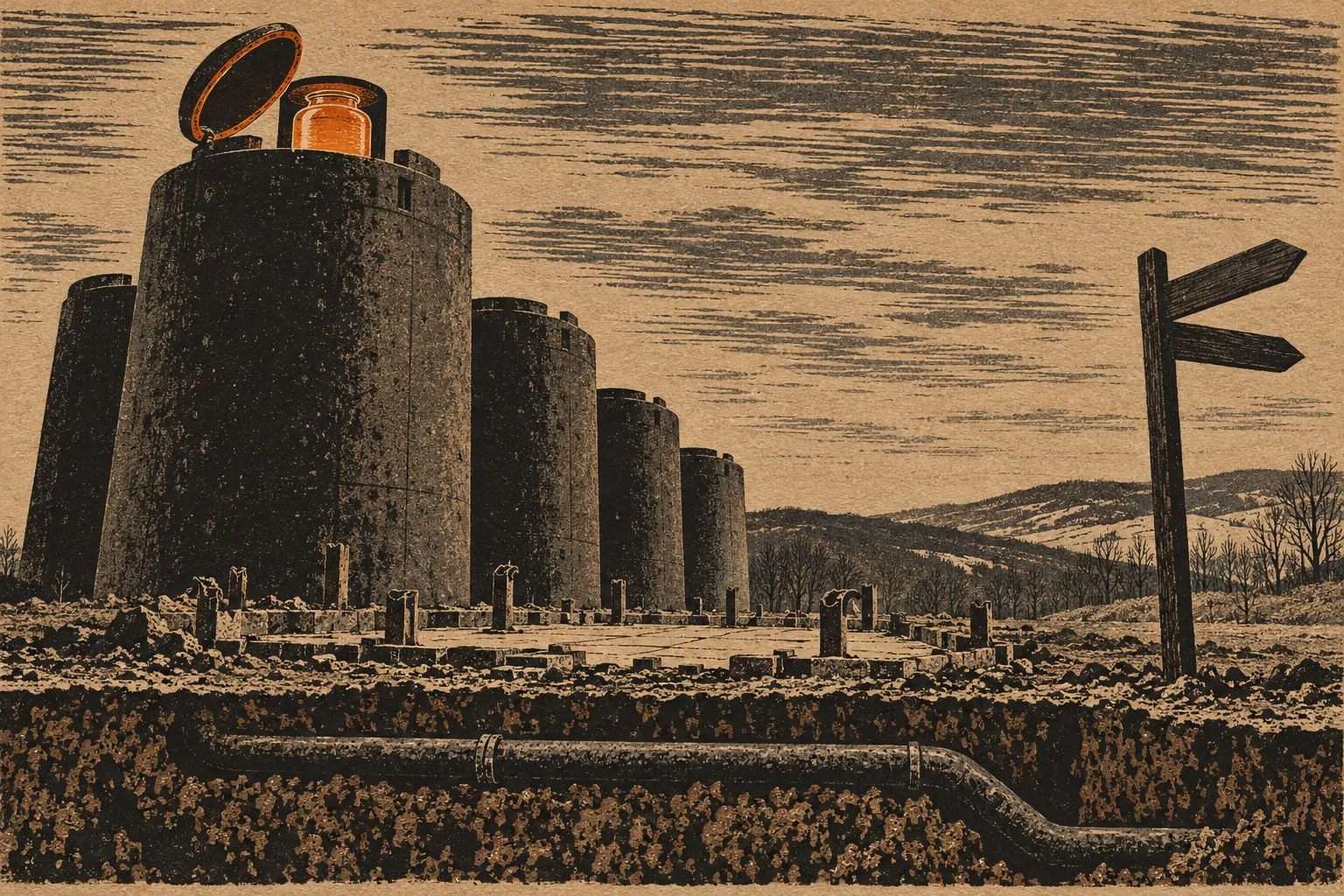
The glass has already moved once. In 2016, the last of 278 canisters of vitrified waste was loaded into 56 vertical storage casks and moved to a storage pad on the site, a year ahead of schedule. Until a repository exists, that pad is where the West Valley reprocessing plant’s most lasting product stays.
About the sources: Figures come mainly from DOE’s environmental impact statement and decommissioning plan, DOE Environmental Management news releases, the NRC, NYSERDA and the U.S. EPA. Cost history and the plutonium figures come from von Hippel’s 2020 analysis for the International Panel on Fissile Materials. Site history comes from the West Valley Citizen Task Force, and the dates of Nuclear Fuel Services’ ownership and exit from Wikipedia.
Edited by a healthcare imaging professional with more than 25 years of experience in the field. How we report and edit.
Read next