
The Nuclear Files
The Soviet Satellite That Scattered a Reactor Across Canada
When Cosmos 954 broke apart over northern Canada in 1978, a satellite failure became a radioactive cleanup and a dispute over who should pay.
Significance 6/10: A nuclear-powered satellite scattered reactor debris across Canada and set a precedent for space liability.
Coverage we found: 2 mainstream news outlets in the past five years (searched October 13, 2026).
How we scored this
- Strength of evidenceRests on a U.S. Department of Energy account, Canada's formal claim and the 1981 settlement protocol.
- Effect on practice or understandingAdds detail to the record of the recovery and the liability claim without overturning it.
- ReachDebris fell across a large but sparsely populated region of northern Canada.
- StakesRadioactive contamination over a wide area, with no doses stated in the article.
- SurpriseThe scale of the search and the half-paid bill are less familiar than the crash itself.
Coverage found
- CBC News mainstream news
- NWT News/North mainstream news
- National Newswatch other, January 24, 2026
- Spider's Web other, February 2024
- Legion Magazine other
- Curiously Polar (podcast) other
Only news, trade and journal coverage is counted. Press releases and other sources, such as reference sites, blogs, social posts and stock-news reprints, are listed but not counted. Searches miss things: tell us about coverage we missed. How the Unread Index works.
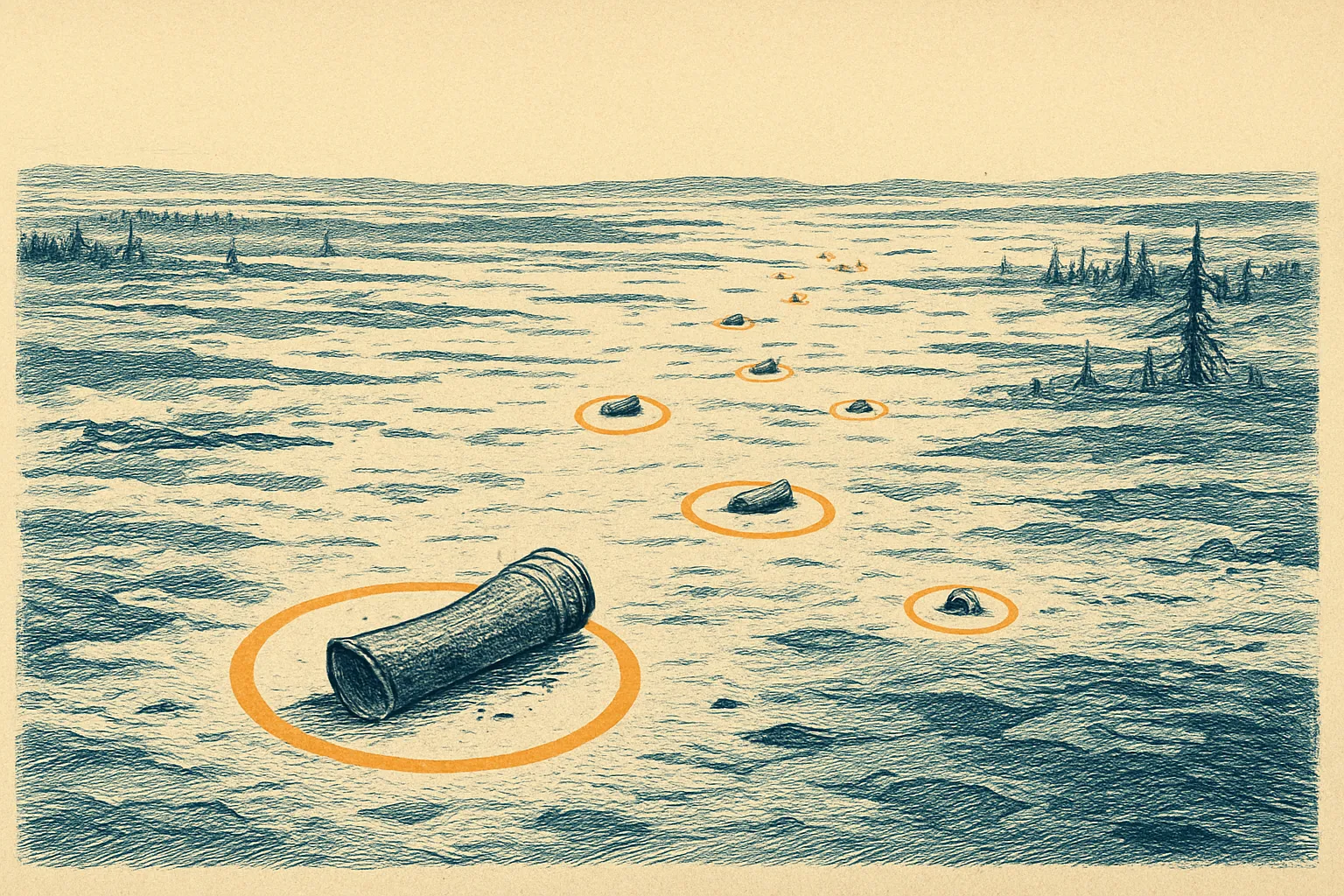
Cosmos 954 came down over northern Canada on January 24, 1978. The search for what it left behind ran until October. The Soviet satellite had carried a nuclear reactor into orbit, and its breakup scattered radioactive debris across a region Health Canada puts at roughly 48,000 square miles, from Great Slave Lake into northern Alberta and Saskatchewan.
Reentry took minutes. Finding the pieces took most of a year.
The reactor aboard Cosmos 954
Cosmos 954, also transliterated as Kosmos 954, was a Soviet surveillance satellite. A U.S. Department of Energy account dates its launch to September 18, 1977, and gives an intended orbit about 150 miles above the oceans. A reactor supplied its electrical power.
As the satellite fell, preparations began for a radiological emergency. American specialists, DOE says, were in Canada on the day of reentry to help Canadian forces find and recover what was left of a spacecraft whose reactor had broken apart.
Operation Morning Light
The joint response to Cosmos 954, Operation Morning Light, combined aircraft surveys, helicopter searches and ground crews carrying radiation detectors. DOE describes a debris footprint roughly 500 miles long.
What the crews recovered ranged from small particles to pipes. There was no intact reactor to retrieve. DOE’s account describes the core disintegrating and its material spreading over a wide area, so the work came down to locating individual sources across a very large landscape.
It also means the search map shouldn’t be read as a dose map. Finding radioactive material establishes contamination. It doesn’t, on its own, say what dose any person received.
Canada’s Cosmos 954 claim was a bill for cleanup
The diplomatic paperwork puts a price on part of that work. In its formal statement of claim, reproduced by Japan’s space agency, Canada asked the Soviet Union for 6,041,174.70 Canadian dollars, an amount covering a selected portion of the response costs rather than the full expense of the operation.
Canada leaned on the 1972 Convention on International Liability for Damage Caused by Space Objects, among other grounds of international law. It argued that the debris, and the work of finding, removing and examining it, counted as compensable damage. It also complained that Soviet authorities hadn’t provided timely, complete information about the satellite.
Those were Canada’s arguments. What it got was a negotiated settlement. Under the protocol signed in Moscow on April 2, 1981, the Soviet Union agreed to pay 3 million Canadian dollars, a little under half of what Canada had asked for, and Canada agreed to accept it as final.
What the accident left behind
Health Canada records that the incident helped prompt international scrutiny of nuclear-powered satellites, including a United Nations working group authorized in November 1978. The question was no longer theoretical: what does a country owe when its spacecraft’s power source lands in someone else’s territory?
One figure remains unsettled. Official summaries give sharply different answers on how much of the reactor was ever recovered.
The rest of the record is plain enough. A reactor went up on September 18, 1977, and came down four months later in pieces across northern Canada. Crews spent most of 1978 finding what they could. Diplomats needed until April 1981 to settle the bill.
Edited by a healthcare imaging professional with more than 25 years of experience in the field. How we report and edit.
Read next