
In Samut Prakan, No One Suspected Radiation for 17 Days
A retired hospital cobalt-60 unit was sold for scrap and cut open in a Thai scrapyard. Ten people received high doses and three died, and it took 17 days for anyone to suspect radiation.
Significance 5/10: A disused hospital cobalt-60 unit became scrap, killing three people and showing how orphan sources escape regulation.
Coverage we found: no other coverage In the past five years (searched 2026-10-22) (searched October 22, 2026).
How we scored this
- Strength of evidenceThe core facts come from an IAEA report, which is an official report. The article's chronology and recovery details were checked only through Wikipedia, not the report itself.
- Effect on practice or understandingThe case informs source-security and orphan-source practice, and the article links it to the later ISO 21482 symbol only as "along with other similar events".
- ReachTen people received high doses and 1,872 lived near the scrapyard, but the event was confined to one area of Thailand.
- StakesThree people died, doses reached over 6 Gy, and the dose rate near the source was as high as 10 Sv/h.
- SurpriseA disused hospital source ending up as scrap repeats an earlier case the article cites, Ciudad Juárez, so it confirms what the field expects.
Coverage found
- Wikipedia other
- Reference.org (reposts Wikipedia) other
- Coconote other
- Nucleus Network other
- Into the Shadows (channel) other
Only news, trade and journal coverage is counted. Press releases and other sources, such as reference sites, blogs, social posts and stock-news reprints, are listed but not counted. Searches miss things: tell us about coverage we missed. How the Unread Index works.
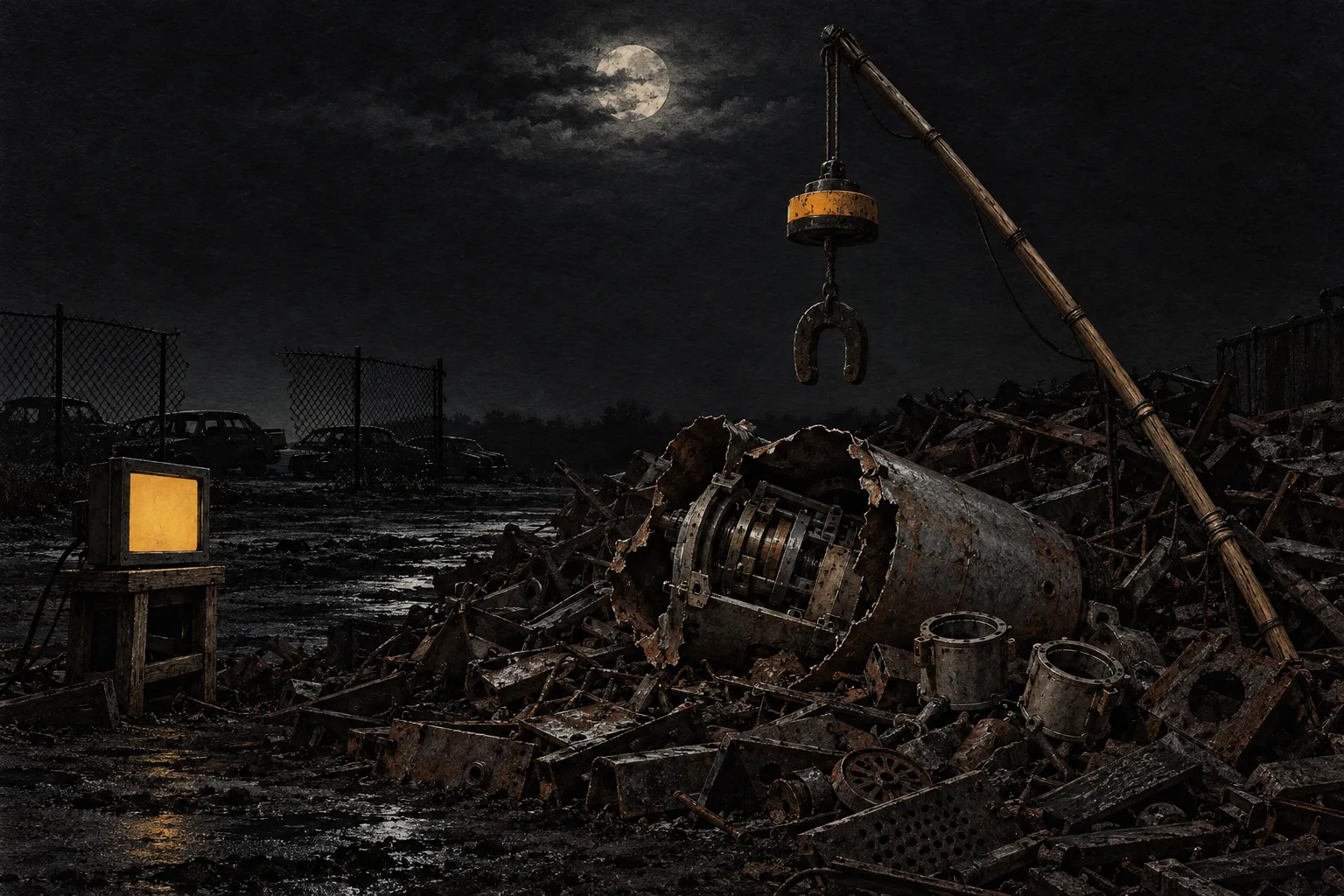
On February 1, 2000, men at a scrapyard in Phra Pradaeng took a cutting torch to a heavy metal assembly bought a week earlier as scrap. Two small cylindrical metal pieces fell out. A worker picked them up and kept them in the yard, unaware that they had held a radioactive source capsule, or that the capsule existed at all. Four men fell ill that same day. It was the start of the Samut Prakan radiation accident, and it would be 17 days before anyone suspected radiation.
The International Atomic Energy Agency (IAEA) published a report on the accident in 2002. Its catalog description says a disused cobalt-60 teletherapy head was partially dismantled, taken from an unsecured storage location and sold as scrap metal in late January and early February 2000.
When responders finally reached the yard, they measured 1 mSv/h at the entrance.
The case matters because of where the source came from: a hospital radiotherapy department, not anywhere exotic. Ten people received high doses, and three of them died within two months, according to the IAEA. Another 1,872 people lived within about 330 feet (100 m) of the scrapyard and were counted as potentially exposed. That figure reflects proximity to the source, not demonstrated harm.
A Siemens Gammatron-3 leaves Ramathibodi Hospital
The machine was a Siemens Gammatron-3, imported in 1969 for Ramathibodi Hospital in Bangkok. Its replacement source was installed in 1981. In 1994 the hospital retired the unit and sold it to a company identified as KSE. Neither party informed the Office of Atoms for Peace (OAEP), Thailand’s nuclear regulator.
The regulator found it anyway. A 1996 OAEP inspection turned up three unlicensed teletherapy units in KSE’s warehouse. When the warehouse lease ended in 1999, the three unregistered units were moved to an unused parking lot in Prawet District. The parking lot was fenced, but the fence had been breached, and nearby residents regularly went in to play soccer.
On January 24, 2000, two scrap collectors acquired the source assembly. Eight days later it was under the torch.
What cobalt-60 does to the body
Cobalt-60 emits beta particles and gamma rays and has a half-life of 5.27 years. Most of its radiation comes out as gamma. As an EPA fact sheet on cobalt-60 puts it, beta particles are generally absorbed in the skin, while gamma radiation can penetrate the body.
That makes a large cobalt-60 source mainly an external hazard. Standing near it is enough; no one has to touch it, inhale it or swallow it. The EPA says mishandling one could produce an external exposure large enough to cause skin burns and acute radiation sickness.
The Samut Prakan source started at 196 TBq in 1981. By 2000 it was estimated at 15.7 TBq, less than a tenth of its starting activity. Even so, the dose rate near it was as high as 10 Sv/h. Surveys found no contamination, and the exposure was external.
That arithmetic is the part worth keeping. Between 1981 and 2000 the source passed through more than three half-lives, and it could still deliver 10 Sv/h at close range. Decay does not make a retired teletherapy head safe to sell, store loosely or forget. The hazard ends only when the source itself is accounted for.
How doctors traced the source from the patients
On February 18, doctors treating the sick men concluded that their symptoms were likely caused by radiation and notified the OAEP. The case had to be solved backward, from bodies to source.
Officers first checked the metal pieces under suspicion. They weren’t radioactive. Then, as the officers approached the scrapyard, their instruments showed abnormally high radiation levels. The two cylinders the worker had kept were empty holders. The capsule they once contained was somewhere else in the yard.
For anyone searching for a lost source, that is the practical warning. The pieces people noticed and kept were not the hazard, and checking them alone read clean. Only the dose rate climbing on the approach to the yard pointed toward the capsule.
Finding a cobalt-60 capsule in the dark
Retrieval began on the afternoon of February 19. The team used a high-range dose rate probe to screen scattered metal pieces. To pin down the capsule’s exact location, they used a fluorescent screen. According to the IAEA report as summarized by Wikipedia, they had to wait for cloud cover to reduce moonlight before it could be used.
Smaller pieces were moved with an improvised electromagnet on an approximately 16-foot (5 m) bamboo rod. The capsule was recovered shortly after midnight, early on February 20. Afterward the scrapyard returned to background levels. The three units in the Prawet parking lot were removed on February 21, and IAEA experts arrived on February 26.
Responders’ doses, measured with individual thermoluminescent dosimeters, did not exceed 32 mSv. Press coverage at the time was critical. According to Wikipedia’s account, the BBC reported that searchers had worked with sticks and cotton gloves. The same account says the IAEA defended the team’s “innovative means” but said the lead aprons were inappropriate.
Doses, deaths and what followed
The four people exposed at the scrapyard were estimated to have received more than 6 Gy. The three deaths were from uncontrolled infection and sepsis.
KSE was fined 15,000 baht. In 2003, Thailand’s Administrative Court ordered the OAEP to pay compensation.
Every link in that chain failed on paper before it failed in the scrapyard. The hospital sold the unit without telling the regulator. The regulator later found the units unlicensed, yet they still ended up in a lot with a breached fence. And the first alarm came from doctors treating patients, not from any inventory of where the source should have been.
The accident also touched on warning symbols. Wikipedia’s summary says the accident, along with other similar events, prompted the IAEA to re-evaluate the trefoil symbol. In 2007 the International Organization for Standardization published ISO 21482, a supplementary radiation warning symbol.
A similar chain of events, a discarded teletherapy source sold for scrap, played out two decades earlier in the Ciudad Juárez cobalt-60 incident.
In 2008, Thailand had two more incidents involving radioactive material in scrap, one with cesium-137 and one with radium-226. No one was injured. In one of them, the dealer recognized the trefoil.
About the sources: The IAEA report is linked through its catalog entry. The chronology, search methods, recovery details and dose estimates come from Wikipedia’s entry on the accident, which cites the IAEA report by page. The BBC account is quoted as relayed there, and the moonlight and fluorescent screen account is attributed to the IAEA report as summarized by Wikipedia.
Edited by a healthcare imaging professional with more than 25 years of experience in the field. How we report and edit.
Read next