
The Delhi Scrap Shop Where a Discarded University Irradiator Was Cut Open
A scrap market in New Delhi became a radiological emergency when a university's discarded irradiator was cut apart. Investigators traced cobalt-60 slugs back to their source, but the case left one death, several injuries and a revised Level 4 rating.
Significance 6/10: A decayed university cobalt-60 irradiator, cut open as scrap, killed one person and injured others in Delhi.
Coverage we found: no other coverage In the past five years (2021-10-15 to 2026-10-15) (searched October 15, 2026).
How we scored this
- Strength of evidenceThe main source is an AERB slide deck reproducing the regulator's own timeline, recovery logs and dose table, which is an official report and not a trial or regulatory decision.
- Effect on practice or understandingThe article's account of how the source was traced informs the understanding of the event and AERB's later measures such as national source inventory checks and eLORA, but it doesn't overturn an accepted account.
- ReachThe exposure was local: seven people in one Delhi scrap market, with follow-up measures in India.
- StakesThe accident caused one death, doses of up to 3.7 Gy and an INES Level 4 rating, and cleanup removed contaminated soil and scrap.
- SurpriseIt adds meaningful detail, such as a source decayed to about 0.5% of its 1969 activity still causing a fatal accident. It doesn't contradict expectations about orphan sources.
Coverage found
- Subhash Verma, LinkedIn Pulse other
- Oncogeek other, 2024-05
- EVS Institute other
Only news, trade and journal coverage is counted. Press releases and other sources, such as reference sites, blogs, social posts and stock-news reprints, are listed but not counted. Searches miss things: tell us about coverage we missed. How the Unread Index works.
On the afternoon of April 7, 2010, a hospital told India’s Atomic Energy Regulatory Board (AERB) that a patient admitted three days earlier, a 32-year-old scrap-shop owner from Mayapuri in New Delhi, had symptoms suggesting radiation exposure. Survey readings that day at the entrance to a shop in the market ran 10 to 15 mSv/h. At another shop about 1,000 feet (roughly 300 meters) away, they reached 15 to 45 mSv/h. That was how the Mayapuri radiation accident first registered: as a medical suspicion and a pair of dose-rate readings, with no source attached to either.
The readings showed that something in the scrap was emitting strongly enough to injure people. AERB did not give the distance at which the readings were taken, so they describe the scene rather than any one person’s dose.
The stakes were concrete and local. The people exposed were scrap workers who handled metal by hand, in shops where cutting spread radioactive material into the floor and soil. The source had to be found piece by piece in a busy market before anyone could say whether all of it had been recovered. The answer emerged from the hardware itself before the paperwork confirmed it.
Cobalt-60 outside its lead
Cobalt-60 emits beta particles and gamma rays and has a half-life of 5.27 years, according to the U.S. Environmental Protection Agency. Its gamma rays can pass completely through the human body. That makes it an external hazard: a person standing near an unshielded piece receives dose without touching it.
According to the U.S. Centers for Disease Control and Prevention, large external exposures can cause skin burns, acute radiation sickness or death. Mayapuri added a second pathway. AERB says cutting the slugs spread contamination around the shop, which turned a sealed source into loose radioactive material.
Three recoveries from the Mayapuri scrap shops
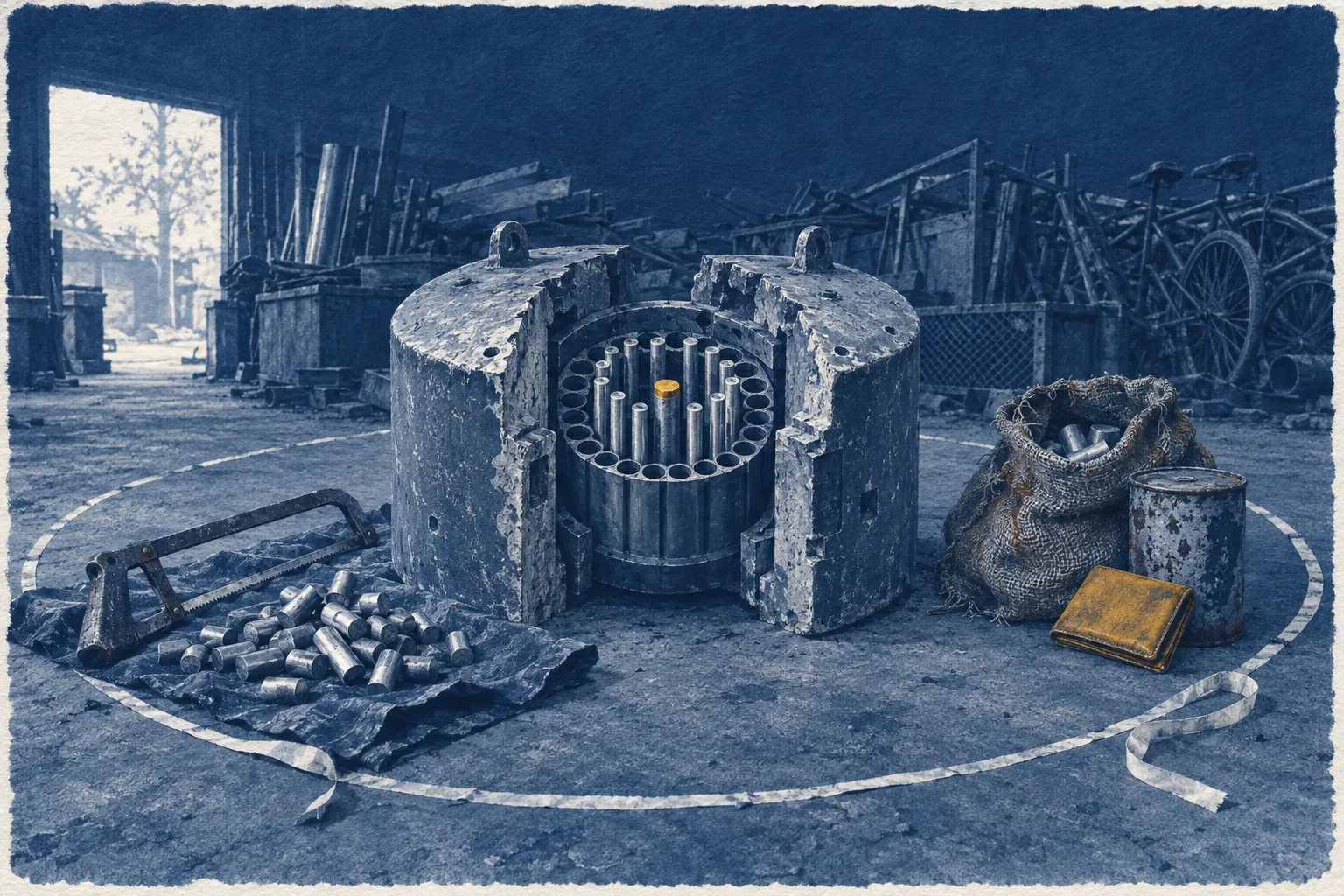
Recovery teams worked in three phases. On April 8 and 9 they removed four pencils, three gunny bags and a drum of radioactive scrap. On April 13 and 14 they found one more pencil, plus a cage with one intact pencil still inside it.
The third phase, on April 16 and 17, produced a single slug. It came from a wallet. AERB rated it at 0.75 Ci.
How the cut pencils pointed to a Gammacell 220
Until mid-April, the recovered objects were hot metal of unknown origin. The pieces went into a hot cell, a heavily shielded enclosure worked with remote manipulators, and were examined there. Investigators also used autoradiography, in which a radioactive object is laid against film so that its own emissions form the image. The results pointed to a gamma chamber, a self-contained irradiator that holds cobalt-60 inside heavy shielding.
Two more details narrowed it down. The pencils’ dimensions didn’t match those of Indian-made pencils. And the slugs had cut marks.
The last link was a human one. Investigators showed victims photographs of gamma cells, and one of them recognized a Gammacell. The scrap dealer then said he had bought the unit at an auction held by Delhi University, and an AERB officer confirmed this at the university. AERB announced the university as the source on April 28. Johnston’s Archive dates the auction to February 26, 2010, and says the unit had arrived in Mayapuri by March 12.
From May 3 to 5, investigators reconciled the recovered fragments against records held by the university, the supplier and AERB. The Press Trust of India (PTI), in a wire report carried by Deccan Herald, wrote that AERB and Bhabha Atomic Research Centre records “could not offer much help,” and that the Canadian supplier, Atomic Energy of Canada Limited (AECL), sent full details within a couple of hours. On May 5, AERB said all of the material was accounted for.
What the Delhi University irradiator held
AERB says the university bought the unit from AECL in 1969. Its source cage had room for 48 pencils and held 16. Each pencil contained seven cobalt-60 slugs and two dummy spacers, 112 slugs in all, and the cage sat inside about 6,600 pounds (three metric tons) of lead. The PTI report carried by Deccan Herald put the inventory at seven pencils of 16 slugs each, which conflicts with AERB’s figure. Another copy of the PTI wire, published by DNA, gives 16 pencils of seven, matching AERB.
The source’s activity in August and September 1969 was 147.186 TBq (3978 Ci). AERB estimated it had fallen to 688.2 GBq (18.6 Ci) by April 2010.
That is a little under half of one percent of the original activity. About four decades of decay had removed nearly all of it, yet the residue, once its lead shielding was stripped away and its slugs cut open in a scrap shop, was enough to produce the readings at the shop door.
Doses, a death and the final event rating
AERB’s dose table lists seven people. Their estimated absorbed doses for a single exposure range from 0.4 to 3.7 Gy. PTI reported eight people exposed, while Johnston’s Archive describes seven hospitalized and one admitted and released.
One person died on April 26. AERB’s table identifies that person as “Person E,” estimated at 1.8 Gy for a single exposure or 3.1 Gy if the exposure stretched over one to two days. That wasn’t the highest estimated dose in the table. Johnston’s Archive identifies the person who died as a 35-year-old worker and reports that the shop owner was still in the hospital on April 28.
AERB gave the event a provisional rating of Level 3 on the International Nuclear and Radiological Event Scale (INES) on April 22. On July 17, 2010, it raised the final rating to Level 4.
Cleanup and the hotspots that followed
The market had been declared safe on April 9. On May 14, a Greenpeace survey reported hotspots of 200 to 500 μSv/h, measured for a person squatting on the ground, according to World Nuclear News. AERB’s decontamination work ran May 15 and 16, May 22 to 24, and June 14 to 18. Teams removed more than 880 pounds (400 kilograms) of soil and 220 pounds (100 kilograms) of scrap, after which AERB says levels returned to background.
World Nuclear News reported that AERB ordered the university to explain the violations and to stop all work with radioactive sources. AERB’s later measures included verifying the national source inventory, issuing public notices, training institutions, increasing inspections and introducing eLORA, an electronic licensing system. Mayapuri belongs alongside a cesium release that crossed Europe before anyone named its source, another case where radioactive material turned up in scrap before anyone could trace where it came from.
The recovered pieces were taken to Narora Atomic Power Station for storage.
About the sources: The decay figures, recovery log and dose table come from a presentation on lessons learned from the accident by Rajoo Kumar of AERB, a slide deck that reproduces the regulator’s own timeline, recovery logs and dose estimates. Johnston’s Archive, a secondary compilation of AERB press releases, is the source for the auction and arrival dates and the identity of the person who died.
Edited by a healthcare imaging professional with more than 25 years of experience in the field. How we report and edit.
Read next