
Visitors Picnicked on Slabs From a Georgia Reactor’s Hot Cell
Georgia released a former Lockheed reactor site in 1972. Four years later, a closer state survey found cobalt-60 hot spots in every once-licensed area, and visitors had been eating at slabs from its old hot cell.
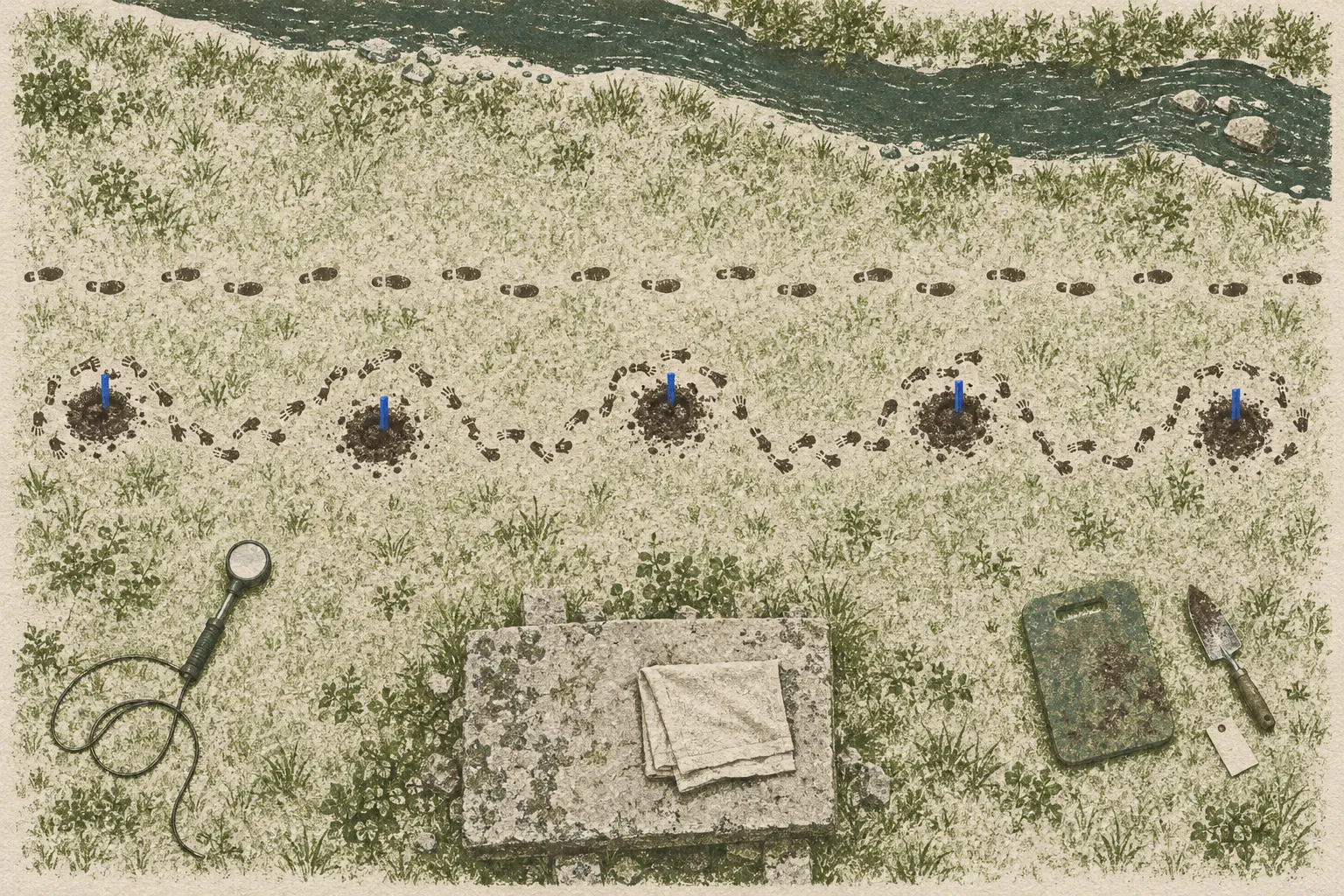
By the time a state crew went back over the grounds of the former Georgia Nuclear Laboratory in 1976, visitors had been using concrete slabs from its old hot cell as picnic tables. The hot cell was the heavily shielded room where workers at the Lockheed reactor site, beside the Etowah River, had once handled cobalt-60 by remote control. Four years earlier, the state had declared the land fit for release, and the City of Atlanta had taken ownership the next day.
The 1976 survey found cobalt-60 hot spots in all five areas that had once been licensed. The 1972 team had cleared the same ground against two criteria: no reading more than 0.2 millirem per hour above background, and no localized spot above 1 millirem per hour. Both were state surveys, four years apart, of the same site. What changed between them was how closely anyone looked.
How the Georgia Nuclear Laboratory Worked
Lockheed bought the land in 1956 and offered it to the Air Force for $1. The facility opened in 1958, the year its reactor reached a self-sustaining chain reaction. In 1966 the General Services Administration sold the site to Lockheed for $1,201,000.
The main machine was the Radiation Effects Reactor, rated at 10 MW, set 750 feet from the Etowah. When it wasn’t running, it rested on a hydraulic lift at the bottom of a 38-foot pool. At full power it was raised into the open air, and its radiation spread unshielded in a full circle around it. A second, shielded reactor of 3 MW, the Critical Experimental Reactor, also operated there.
That open-air design made the site a field laboratory for what radiation does to living things. In one experiment, Emory ran the reactor at full power for 10 hours. That fall, the trees nearest the reactor shed their leaves up to a month early. The next spring they leafed out a month late, and then the vegetation began to die.
Irradiated materials moved through the site in plain view, riding uncovered rail cars across the Etowah to a cooling-off area and from there to the hot cell.
The 1967 Hot Cell Accident and Cobalt-60
The hot cell began cobalt-60 work in 1967. Later that year a mechanical failure kept a damper from opening, pressure inside the cell rose, and cobalt-60 entered the laboratory building’s air system. Mark Ham, a former health physicist at the site, described the event as the fans reversing. According to former employees, decontamination cost nearly half a million dollars.
Cobalt-60 forms when metal, such as steel rods, is exposed to neutron radiation. It has a half-life of 5.27 years and emits beta particles and gamma rays, according to the U.S. Environmental Protection Agency’s radionuclide reference on cobalt-60. It decays to non-radioactive nickel, so no short-lived decay product is involved.
That gives it two exposure routes. The gamma rays make it an external hazard, and external gamma exposure raises cancer risk. Particles that are inhaled or swallowed add an internal route: most ingested cobalt-60 is excreted, but a small amount is taken up by the liver, kidneys and bones.
At this site, the records link the contamination to the hot cell’s cobalt-60 handling, the 1967 accident, leaking waste drums and dust from the cleanup, not mainly to activation of the surrounding soil. The date and cause of the drum leak at the cooling-off area are uncertain.
The reactor stopped operating on July 16, 1970. Decommissioning followed, and Lockheed’s cleanup bill was reportedly close to $5 million. One step in that cleanup spread the very material it was meant to remove. Workers jackhammered the air duct that had been contaminated in 1967, and the dust carried minute particles of cobalt-60 across the site. State supervisors decided it was impossible to pick all of it up.
Why the 1972 and 1976 Surveys Disagreed
The 1976 state environmental survey was documented in a report by T. Roland Phillips. Richard Fetz, head of the state Radiological Health Service, explained the difference between the two surveys: in 1972, his men had simply walked an area measuring general radiation, while Phillips’ crew scoured the ground on hands and knees, finding localized hot spots. James Setser, identified in the 1979 account as supervisor of the state radiation unit, cited a different factor: a change in philosophy since 1972.
Two published accounts give figures from the 1976 work, and they are separate measurements, not conversions of one another. The 1991 article lists annual figures of up to 850 mrem per year at the reactor seepage pit, 2,278 mrem per year at the hot-cell pit and 8,760 mrem per year at one cooling-off spot. The 1979 article lists hourly readings of 50 and 100 mrem per hour at two cooling-off spots.
Phillips’ report also found a significant internal-exposure hazard from inhaling or ingesting particles in every area except the reactor area. That is a different kind of risk from the one the 1972 criteria were written to catch, which were set in millirem per hour on an instrument.
What the Georgia Nuclear Laboratory Left Behind
Fences at the site were reported on March 9, 1977. A Nuclear Regulatory Commission flyover costing $40,000 confirmed the 1976 conclusions. On May 14, 1978, the Atlanta Constitution ran the story on its front page, and its reporters found a hole in the hot cell.
As of 1979, no radiation illness had been reported among visitors. NRC staff said experts disagreed about risk at low doses. Lockheed’s records showed that river water quality was never compromised. In 1991, the Georgia Environmental Protection Division said two areas were still contaminated and the debris was too “hot” to remove without spreading it, and after the reporting the state ordered a task force.
In 2020, James Mahaffey told the Dawson County News that traces of cobalt-60 remain around the hot cell but are “probably not” dangerous. The arithmetic of decay points the same way. No new cobalt-60 has been made at the site since the reactor stopped in 1970, and at a half-life of 5.27 years, whatever was there then has passed through more than ten half-lives, leaving less than a thousandth of its activity. The ground is quieter now than any crew ever measured it. What it still records is how much the verdict on a site can depend on whether someone walks it or kneels to look.
About the sources: This account draws on two Southern Exposure articles: “The Leavings of Power,” by Mitchell Shields and Bill Brooks, published in March 1979, and “The Nuclear Forest,” by Karen Kirkpatrick, published in December 1991, which reprints a Gainesville Times investigation. Both rely on Lockheed and state records. Brooks also helped bring the story to the Atlanta Constitution, so the 1979 article and the 1978 newspaper coverage are not fully independent of each other.
Edited by a healthcare imaging professional with more than 25 years of experience in the field. How we report and edit.
Read next