
The Nuclear Files
The Chernobyl Sunflower Rafts That Cleaned Water, Not Soil
Sunflower rafts at Chernobyl worked on contaminated water, not soil, yet the popular story blurred the two. Measurements from Fukushima rice fields show why the difference matters for any plant-based cleanup of cesium.
Significance 5/10: Sunflowers filtered Chernobyl pond water, but the soil record at Fukushima shows plants barely remove cesium from land.
Coverage we found: no other coverage In the past five years (searched 2026-10-20) (searched October 20, 2026).
How we scored this
- Strength of evidenceThe key figures come from an official JAEA report relaying Japan's MAFF trial data. The Chernobyl raft claims rest only on a 1997 university news release with no measured removal figures.
- Effect on practice or understandingIt informs the accepted account by separating water cleanup (Chernobyl rafts) from soil cleanup (the failed Fukushima trial). It does not change any current guideline.
- ReachIt bears on contaminated sites at Chernobyl and Fukushima, which makes it a regional, specialty topic.
- StakesThe consequences are indirect: spent plants become radioactive waste, and the trials suggest plants are a poor way to remove cesium from soil. The article gives no safety or dose consequences.
- SurpriseIt adds meaningfully by correcting the popular "sunflowers cleaned Chernobyl land" story. Researchers familiar with the field already knew that cesium binds to soil.
Coverage found
- ScienceABC other
- UA Magazine other, 2022-03-27
- Discover Wildlife other
- Connecting the Dots Project other
- inkl other
Only news, trade and journal coverage is counted. Press releases and other sources, such as reference sites, blogs, social posts and stock-news reprints, are listed but not counted. Searches miss things: tell us about coverage we missed. How the Unread Index works.
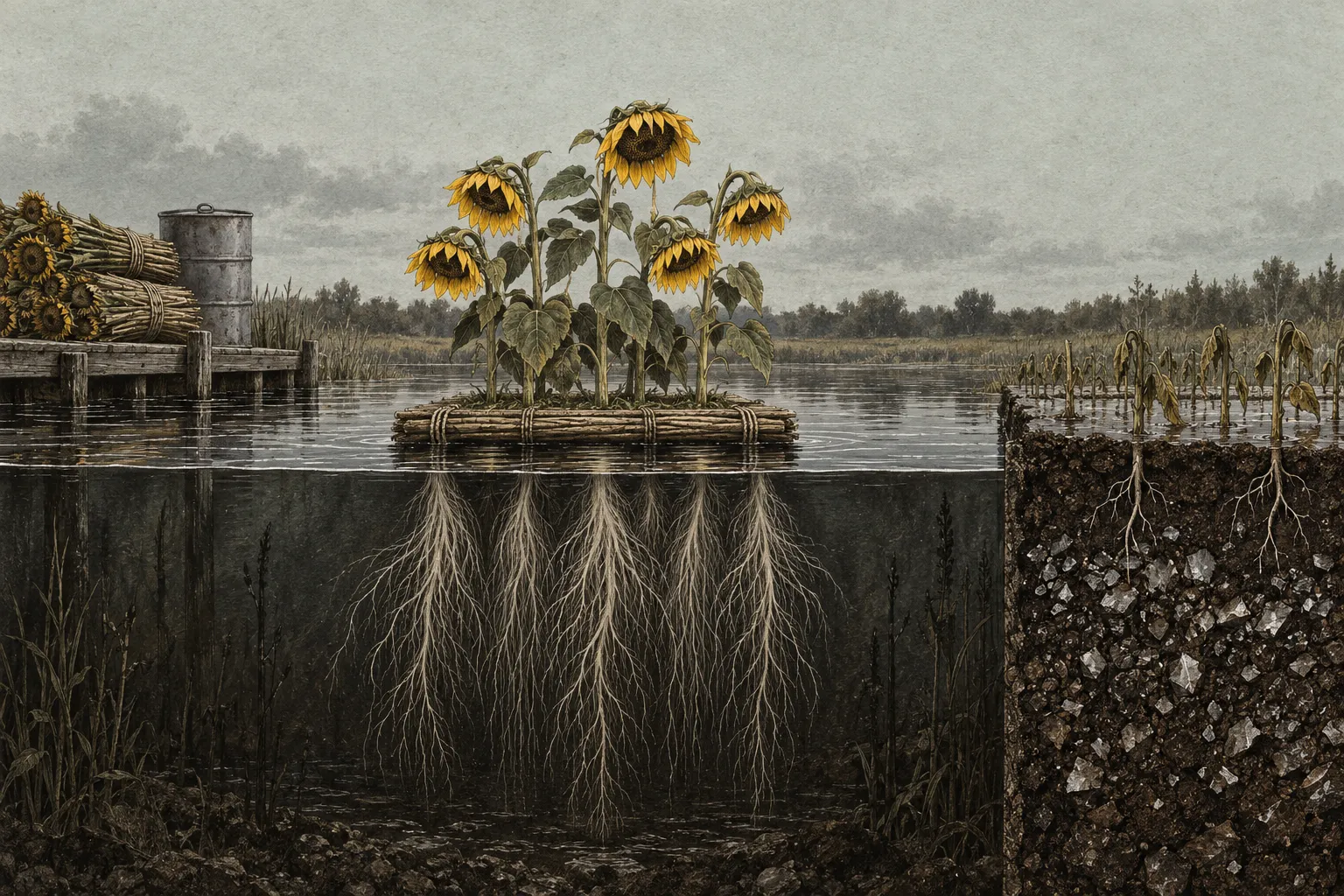
Floating rafts of sunflowers set on radioactive water at Chernobyl, their roots hanging down into it, sound like a greenhouse idea. Purdue News described the method in April 1997. According to the university’s release, the dangling roots pulled cesium 137 and strontium 90 out of the water. The rafts were run by Phytotech, a phytoremediation company based in New Jersey. Once the plants had done their work, they were disposed of as radioactive waste.
The release was written mainly about two Purdue scientists, Goldsbrough, a horticulture professor, and Webb, a botany professor, and neither of them did the Chernobyl work. It carries Phytotech’s estimated cost of $2 to $6 per thousand gallons of water, an estimate rather than an audited number.
One line in the release tends to get lost. For contaminated soil, Phytotech also used Indian mustard, not sunflowers, against Chernobyl fallout, and the release gives no results for that work. That distinction has since blurred into a popular story that sunflowers cleaned the land around Chernobyl.
The difference between water and soil is the whole story. Roots can take up cesium and strontium dissolved in a pond. But in 2011, when Japan tested sunflowers on contaminated rice fields in Koriyama City and Iitate Village in Fukushima Prefecture, the same idea did poorly, and the measurements from those fields make the sunflower story checkable.
What the Chernobyl Sunflower Rafts Were Built to Do
Phytoremediation means using living plants to draw contaminants out of water or soil so the plants can be harvested and removed. On the Chernobyl rafts, the plants never touched ground. Their roots sat directly in the contaminated water.
Strontium was the easier target to explain. As the Purdue release put it, strontium can mimic calcium in biological systems, so a plant takes it up through the same pathways it uses to gather calcium.
Collecting radioactive contaminants is what made the harvested plants a waste problem. One of those contaminants, cesium 137, emits beta particles and gamma rays and has a half-life of 30.17 years. The gamma rays come from its short-lived decay product, barium-137m, which has a half-life of 2.6 minutes. Because of that gamma emission, cesium is an external radiation hazard as well as an internal one if it’s swallowed or inhaled. A plant that has concentrated it stays radioactive after it’s pulled from the water.
Why would the approach work on a pond and stumble in a field? In water, the cesium and strontium are already dissolved and in contact with the roots. In soil, much of the cesium isn’t free to move. A ScienceABC explainer attributes the poor Fukushima result to cesium being tightly fixed to mica and clay minerals, and notes that the Chernobyl demonstration targeted water, not soil. A root can only take up what the soil will give it.
Sunflowers in the Rice Fields of Koriyama and Iitate
The 2011 sunflower trial by Japan’s Ministry of Agriculture, Forestry and Fisheries (MAFF) planted sunflowers in shallow rice fields with soil cesium of 1,045 Bq/kg in Koriyama City and 7,715 Bq/kg in Iitate Village. Those values come from a report by O. Amano of the Japan Atomic Energy Agency (JAEA), which relays the MAFF data.
The plants held far less. Above-ground parts measured 12 to 79 Bq/kg, and roots 64 to 232 Bq/kg. Even the highest root value sat well below the soil value at the less contaminated site. These are specific activities, not radiation doses to anyone.
Amano wrote that the MAFF results “suggest that using sunflower plants to remove cesium is inefficient.” A separate study of cesium accumulation in the terrestrial cyanobacterium Nostoc commune reports that the 2011 MAFF sunflower experiment “was not successful.”
Amaranth and the Soil Problem
Sunflowers weren’t the only plant tried on contaminated ground. A 1999 paper by Dushenkov, Mikheev, Prokhnevsky, Ruchko and Sorochinsky in Environmental Science & Technology is cited in later Japanese work as an example in which amaranth (Amaranthus spp.) plants were used to remove radioactive Cs from contaminated soil. Dushenkov returned to the subject in 2003 with a review, “Trends in phytoremediation of radionuclides,” written from a Rutgers affiliation.
The Fukushima-era amaranth work measured how far that idea goes. In a 2015 study in the Japanese Journal of Crop Science, Ogata, Fujita and Kato found that a one-time amaranth crop removed only 0.019% to 0.283% of soil cesium. They concluded that cleaning cesium from Fukushima-area soil with amaranth wasn’t practical.
The same study reported one lever that did move the numbers. In Japanese paddy trials, lower soil potassium enhanced the uptake of cesium. Even so, a crop that takes up a fraction of a percent of the cesium in one season leaves nearly all of it in the soil.
About the sources: The Chernobyl raft details come from a 1997 Purdue News release, a university news release relaying Phytotech’s work, which reports no measured removal figures. The Fukushima figures come from O. Amano’s JAEA report, the cyanobacterium study in PubMed Central, and the 2015 amaranth abstract; the ScienceABC piece is a popular explainer.
Edited by a healthcare imaging professional with more than 25 years of experience in the field. How we report and edit.
Read next