
The Nuclear Files
The Spy Mission That Left a Plutonium Generator Missing in the Himalayas
A plutonium-238 generator left on Nanda Devi in 1965 was never found, at the head of a watershed that feeds the Ganges. The records show a real loss, a 1978 scare and decades of testing with no documented release.
Significance 6/10: A lost plutonium generator whose documented record is narrower than its legend.
Coverage we found: 6 mainstream news outlets in the past five years (searched October 13, 2026).
How we scored this
- Strength of evidenceDeclassified U.S. records, a parliamentary statement and an Indian scientific review.
- Effect on practice or understandingClarifies what is documented about a lost plutonium source, without changing practice.
- ReachConcerns a watershed that feeds the Ganges.
- StakesA lost alpha-emitting source with no documented release.
- SurpriseWidely retold, but the record is narrower than the retellings.
Coverage found
- The New York Times mainstream news, December 13, 2025
- The Week mainstream news, December 14, 2025
- La Voce di New York mainstream news, December 13, 2025
- Dawn mainstream news
- The Wire mainstream news
- Business Today mainstream news, 2025
- Boing Boing other
Only news, trade and journal coverage is counted. Press releases and other sources, such as reference sites, blogs, social posts and stock-news reprints, are listed but not counted. Searches miss things: tell us about coverage we missed. How the Unread Index works.
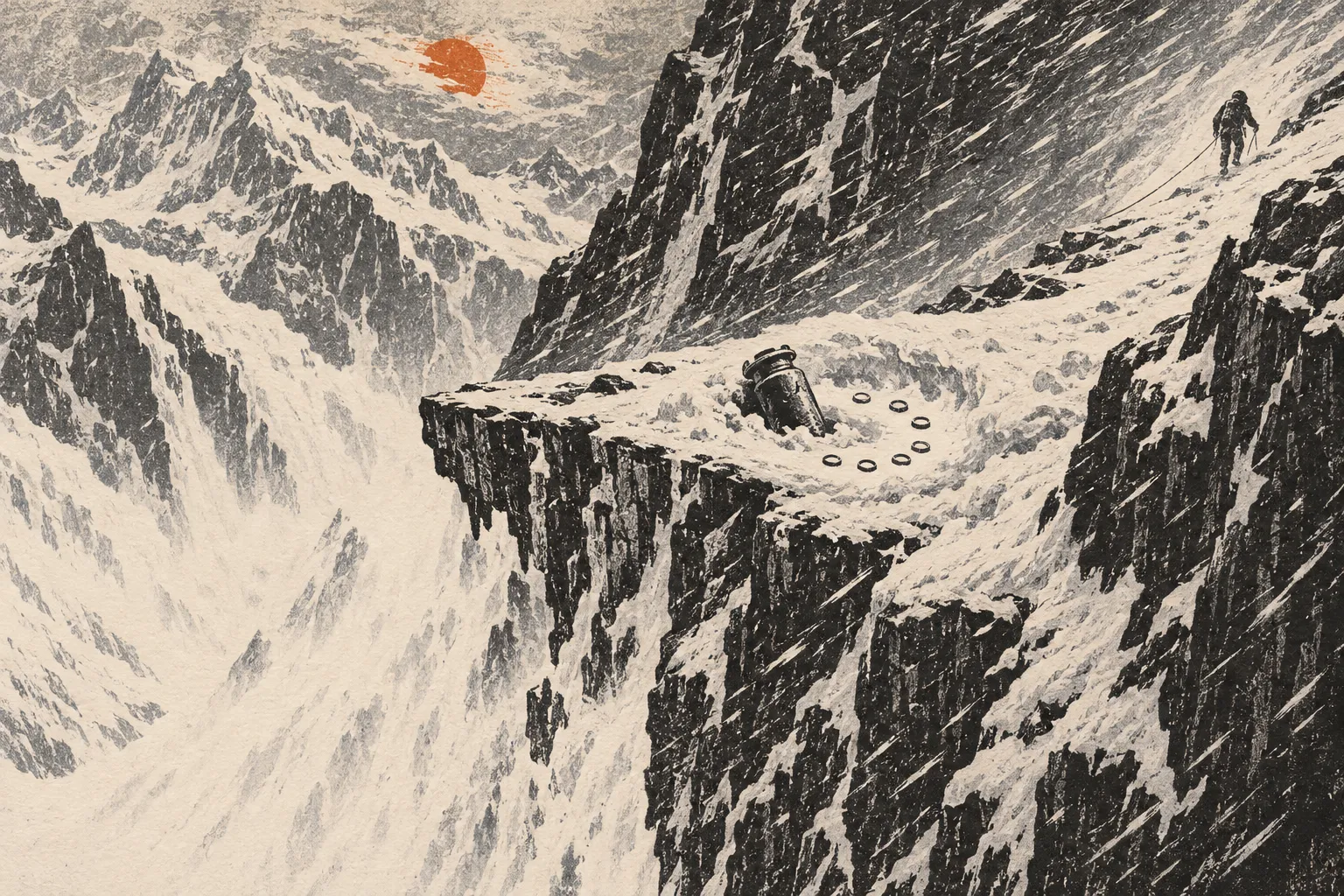
On October 16, 1965, a climbing party on Nanda Devi, in the Indian Himalaya, turned back from Camp IV in a blizzard. The expedition’s leader, Lt. Cmdr. M.S. Kohli of the Indian Navy, gave the order, and the team left behind the plutonium-powered generator it had carried up, a machine that became known as the Nanda Devi nuclear device. The date fell one year to the day after China conducted its first successful nuclear test at Lop Nor.
That test was the reason the generator was there. The joint American and Indian operation was meant to monitor China’s nascent nuclear and missile program, and the generator would power a remote telemetry station on the summit.
Inside the generator were seven capsules containing plutonium-238, an isotope with a half-life of about 88 years. Accounts disagree even on the weight of the whole unit: historian Paul McGarr gives 123 lb, while Pakistan’s Dawn newspaper puts it at about 50 pounds.
The stakes are geographic. Meltwater from the Nanda Devi basin drains into the Rishi Ganga, which feeds the Alaknanda and, downstream, the Ganges, a river hundreds of millions of people depend on. A sealed radioactive heat source went missing at the top of that watershed. Classified American documents, an Indian scientific review and years of water testing all describe the same loss, and none of them documents a release.
Much of the account below follows McGarr’s reconstruction for War on the Rocks, alongside the State Department’s own record of how Washington handled the affair in 1978.
Inside the Nanda Devi nuclear device
The generator was a SNAP-19C. It converted heat from radioactive decay into electricity, which suited a station that would sit for long periods without fuel deliveries or maintenance.
Half-life is the time it takes for half the atoms in a sample to decay. At about 88 years for plutonium-238, the heat output barely drops over the life of a mission, which is what made the isotope useful for remote power.
That heat was noticeable. The New York Times reported that the device gave off enough warmth to make it strangely desirable to carry on a frozen mountain.
The hazard lay in the plutonium itself, and in how it could reach a person. Plutonium-238 is an alpha emitter. Its radiation is stopped by a sheet of paper or the outer layer of skin, so it poses little danger from outside the body. Taken in, it is another matter: plutonium-238 could cause cancer if inhaled or ingested. That is why the question that mattered was never how close someone stood to the device, but whether any of its contents had escaped into air or water.
Searching, 1966 to 1968
Between 1966 and 1968, at least three efforts to secure the plutonium-powered telemetry unit were fruitless. The Times reported that the ledge where the generator had been left was gone, and subsequent searches using radiation detectors and infrared sensors found nothing.
No one saw what happened. Officials concluded the lost device was likely buried by an avalanche or lost in a crevasse, a conclusion drawn from the missing ledge rather than from any witness.
Meanwhile, the operation moved to a neighboring peak. During 1967-68, a device was installed near the summit of Nanda Kot, where it returned data for several months before failing, and a climbing team recovered it in summer 1968.
Is the Nanda Devi nuclear device a contamination risk?
India’s monitoring is the most direct evidence. Water from the Nanda Devi range was tested until 1970, and its quality was monitored for years afterward. No contamination was found.
The fear has never fully gone away. In February 2021, a flood tore down the Rishi Ganga valley and destroyed hydropower works near the village of Raini. Residents asked whether the lost device was to blame and called on the government to find it. Scientists quoted in that coverage called the idea that the plutonium could explode far-fetched, and experts attributed the disaster to glacial and climate processes.
The spring of 1978
For more than a decade, the loss stayed out of public view. Then, in the spring of 1978, the story appeared in Outside magazine and on the April 12 broadcast of the Today show. The State Department record places the Outside article in the April issue, while a congressional letter cites the May issue, so the records disagree on which issue ran it.
The timing put a second lost nuclear power source in the news within months. In January 1978, the Soviet satellite Cosmos 954 broke apart over northern Canada and scattered radioactive reactor debris.
Members of Congress wrote to President Jimmy Carter. Their letter, now in the CIA’s FOIA reading room, said: “One of the monitoring stations is said to have been buried by an avalanche, and thus might be currently leaking plutonium.” It offered no measurement.
On April 14, Acting Secretary of State Warren Christopher sent Carter an internal memorandum, not a public statement. It said that one of the two monitoring devices was lost in an avalanche and never functioned, and that the second functioned for several years before it was removed. McGarr’s account differs on the second device, describing the Nanda Kot unit as working for several months.
The same memo said the United States was reviewing a 1967 Atomic Energy Commission study “to ensure that we can confirm to the Indian Government that we see no environmental danger.”
On April 17, Prime Minister Morarji Desai addressed the Lok Sabha, the lower house of India’s Parliament. He confirmed that one device had been lost on Nanda Devi and said the environmental threat it posed was uncertain.
Six scientists and a verdict
Desai’s government convened a review committee of Atma Ram, Homi Sethna, M.G.K. Menon, Raja Ramanna, V. Ramalingaswami and A.K. Saha. On May 18, 1979, Desai tabled its report and key findings in Parliament. The committee judged the risk of a significant radiation hazard to be negligible, while recommending further efforts to trace the device.
According to NewsGram, the panel also recommended regular monitoring of air, soil and water near Nanda Devi and the development of new detection techniques.
Inside the recordThe 4 documents this story rests on
-
April 1978
Letter from members of Congress to President Jimmy Carter
Members of the U.S. Congress · Letter, now in the CIA FOIA reading room
What it shows: Lawmakers wrote that one monitoring station was said to have been buried by an avalanche and might be leaking plutonium.
What it does not show: It offered no measurement. The leak was raised as a possibility, not a finding.
-
April 14, 1978
Memorandum from Acting Secretary of State Warren Christopher to the President
U.S. Department of State · Internal memorandum (Foreign Relations of the United States)
What it shows: One of the two monitoring devices was lost in an avalanche and never functioned; the United States was reviewing a 1967 Atomic Energy Commission study to confirm it saw no environmental danger.
What it does not show: It does not say where the lost device is. Its account of the second device differs from the historian Paul McGarr, who says it worked for several months.
-
April 17, 1978
Statement by Prime Minister Morarji Desai to the Lok Sabha
Government of India · Parliamentary statement, as described by War on the Rocks
What it shows: Desai confirmed that one device had been lost on Nanda Devi and said the environmental threat it posed was uncertain.
What it does not show: It does not quantify any risk or describe any measurement.
-
May 18, 1979
Report of the scientific review committee, tabled in Parliament
Committee of Atma Ram, Homi Sethna, M.G.K. Menon, Raja Ramanna, V. Ramalingaswami and A.K. Saha · Scientific review, as reported by The Week
What it shows: The committee judged the risk of a significant radiation hazard to be negligible and recommended further efforts to trace the device.
What it does not show: It did not locate the device or establish its condition.
What remains unknown
Nobody knows where the Nanda Devi nuclear device is now, or what condition it is in. The absence of a documented release is not proof that the plutonium-238 capsules remain sealed inside an intact generator. What the record supports is narrower: a lost sealed source, a 1978 scare built on a possibility, and, more than half a century on, no documented release.
About the sources: Most recent press coverage traces back to a December 2025 New York Times feature and, before that, to Spies in the Himalayas, the 2002 book by Kohli and Kenneth Conboy. The State Department record is one of the main independent strands.
See where this and other stories took place on the Nuclear Files map.
Edited by a healthcare imaging professional with more than 25 years of experience in the field. How we report and edit.
Read next