
The Nuclear Files
The $10 Scrap Sale That Put Radioactive Rebar in Mexican Homes
A cancer-therapy machine sold as scrap for $10 in 1983 was melted into rebar and table legs, exposing about 4,000 people. It came to light only when a truckload of radioactive steel took a wrong turn at Los Alamos.
Significance 8/10: A discarded cancer-therapy source became radioactive rebar and furniture across Mexico, exposing about 4,000 people.
Coverage we found: 3 mainstream news outlets in the past five years (searched October 14, 2026).
How we scored this
- Strength of evidenceRests on the Mexican regulator CNSNS 1985 accident report and NRC inspection records.
- Effect on practice or understandingShows how an orphaned therapy source can enter the scrap-metal stream, a lesson behind later scrap monitoring.
- ReachAbout 4,000 people were exposed and contaminated rebar reached 17 Mexican states and several U.S. cities.
- StakesFive people received 3 to 7 Sv, two workers became sterile, and 814 buildings required demolition.
- SurpriseFew readers know a $10 scrap sale put radioactive steel into Mexican buildings and furniture.
Coverage found
- Amusing Planet other, 2023-06
- El Universal mainstream news
- Milenio mainstream news
- El Tiempo mainstream news
- Xataka México other
Only news, trade and journal coverage is counted. Press releases and other sources, such as reference sites, blogs, social posts and stock-news reprints, are listed but not counted. Searches miss things: tell us about coverage we missed. How the Unread Index works.
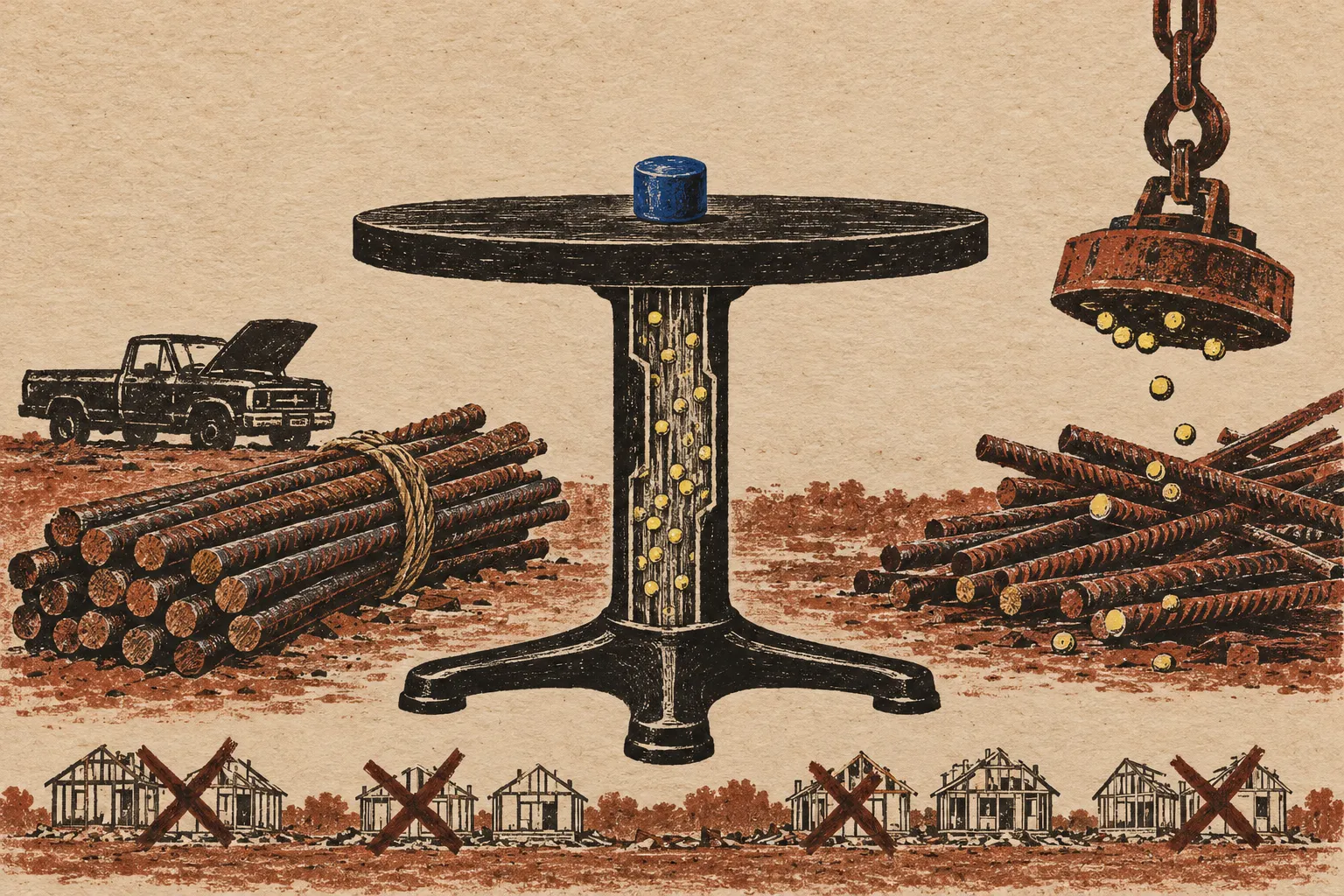
On January 16, 1984, a truck carrying steel reinforcing bar took a wrong turn at Los Alamos National Laboratory in New Mexico and set off a radiation alarm. The load was contaminated with cobalt-60. In language from the U.S. Nuclear Regulatory Commission’s inspection manual, reproduced by the ORAU Museum of Radiation and Radioactivity, the shipment had been “mistakenly delivered” and the rebar was “inadvertently contaminated with cobalt-60.” It had come from a Mexican supplier through a broker in Phoenix, Arizona.
The alarm started an investigation that ran backward through the supply chain: from the steel to two foundries, from the foundries to a scrapyard, and from the scrapyard to a radiotherapy machine that had sat unused in a Ciudad Juárez hospital warehouse for years. Its source had been scavenged, sold as scrap and melted into rebar and furniture. About 4,000 people were exposed, contaminated rebar was shipped to 17 Mexican states, and 814 buildings had to be demolished.
A cancer-treatment machine that never treated anyone
In November 1977, Centro Médico de Especialidades, a private hospital in Ciudad Juárez, bought a Picker C-3000 teletherapy unit, a machine that aims a beam of cobalt-60 gamma rays at tumors. The hospital had no qualified staff to run it, and the unit sat in storage for almost six years.
Its source was not one sealed slug but about 6,000 small cobalt-60 pellets, each holding about 70 millicuries (2.6 GBq).
Cobalt-60 is made in reactors by bombarding stable cobalt-59 with neutrons, and it has a half-life of about 5.27 years. Each decay releases a beta particle and then two penetrating gamma rays, at about 1.17 and 1.33 MeV. The beta particles barely leave a pellet; the gamma rays pass through air, clothing and the steel of a truck. That made a loose pellet mainly an external hazard to anyone nearby, and easy to detect at a distance.
Sold for $10, then parked on Aldama Street
On December 6, 1983, according to the 1985 report of Mexico’s nuclear regulator, the National Commission for Nuclear Safety and Safeguards (CNSNS), hospital employee Vicente Sotelo Alardín dismantled the unit. A second man, Ricardo Hernández, helped load it onto Sotelo’s pickup, and the punctured source capsule spilled about 1,000 pellets into the truck bed.
The men sold the machine to a local scrapyard for $10. The pickup’s battery then died, and the truck sat on Aldama Street, near Sotelo’s home, for about six weeks. Neighbors gathered around it to talk, and Sotelo’s children held a tea party inside it. Investigators later measured an exposure rate of 50 R/h three feet from the driver’s side of the cab. That figure describes the radiation field at one spot; what each person absorbed depended on how close they stood and for how long.
How the scrapyard’s magnets spread the pellets
Cobalt is magnetic, and scrapyards move metal with electromagnetic cranes. When a crane dropped the teletherapy unit, the pellets still inside scattered across the yard. Others clung to the magnet and left mixed into outgoing scrap. The equipment that sorted steel efficiently distributed the source just as efficiently.
Two foundries melted the source into rebar and table legs
The contaminated scrap went to two foundries: Aceros de Chihuahua (Achisa), a rebar maker in the city of Chihuahua, and Falcón de Juárez, a maquiladora that made pedestal table bases for fast-food restaurants.
Melting did not destroy the radioactivity. Decay is a nuclear process, and furnace heat has no effect on it. The furnaces mixed the cobalt-60 through the molten steel, turning a few concentrated sources into weaker activity spread through a far larger mass. By the CNSNS count, that came to about 6,000 tons of rebar and some 30,000 table bases, all shipped as ordinary merchandise.
From the Los Alamos alarm back to Juárez
On the day of the Los Alamos alarm, five more trucks carrying contaminated steel were stopped at a border crossing in El Paso, Texas. Within three days, investigators had traced the rebar to both foundries and found the scrapyard and the pickup.
Decontamination began in Mexico on January 20. On January 26, CNSNS staff found an abandoned truck emitting up to 1,000 roentgens per hour in a densely populated area and had it hauled by crane to El Chamizal Park.
About 4,000 people exposed, five severely
The CNSNS report on the accident estimated that about 4,000 people were exposed. Nearly 80 percent received less than 500 millirem (5 mSv), and 18 percent received between 0.5 and 25 rem (5 to 250 mSv). About 2 percent, roughly 80 people, received more than 25 rem (250 mSv). Five received between 300 and 700 rem (3 to 7 Sv) over about two months, and three of Sotelo’s neighbors received more than 100 rem (1 Sv).
Two scrapyard workers became sterile, “possibly permanently,” according to the ORAU museum, which states that no one died. Johnston’s Archive, a private database of radiation incidents, lists one worker who later died of bone cancer.
Radioactive rebar in 17 states and 814 condemned buildings
Rebar from Achisa had been shipped to 17 Mexican states, and several U.S. cities received contaminated material. By June 1984, more than 1,000 tons were still unaccounted for. CNSNS recovered 2,360 tons of unused rebar and all 30,000 table bases, inspected more than 17,000 buildings, and found that 814 structures required demolition.
The waste had a long afterlife of its own. In February 1984, CNSNS chose a site called La Piedrera in the Samalayuca desert, which began receiving rebar that September. About 110 tons of waste spent 1985 to 1998 outdoors in the Sierra de Nombre de Dios before being moved to Samalayuca without proper shielding, the Mexican newspaper El Universal reported in 2001. A 2004 analysis by the National Autonomous University of Mexico (UNAM) found radiation at Samalayuca still dangerously high.
No regulator, hospital or scrapyard flagged the missing source. A delivery truck’s wrong turn in New Mexico did.
About the sources: The account of the scrapping, the parked truck and the scrapyard comes from the ORAU Museum of Radiation and Radioactivity, which draws on material donated by the Arizona Radiation Regulatory Agency. Exposure, recovery and storage figures come from the 1985 CNSNS report as summarized in the Wikipedia entry on the incident.
Edited by a healthcare imaging professional with more than 25 years of experience in the field. How we report and edit.
Read next